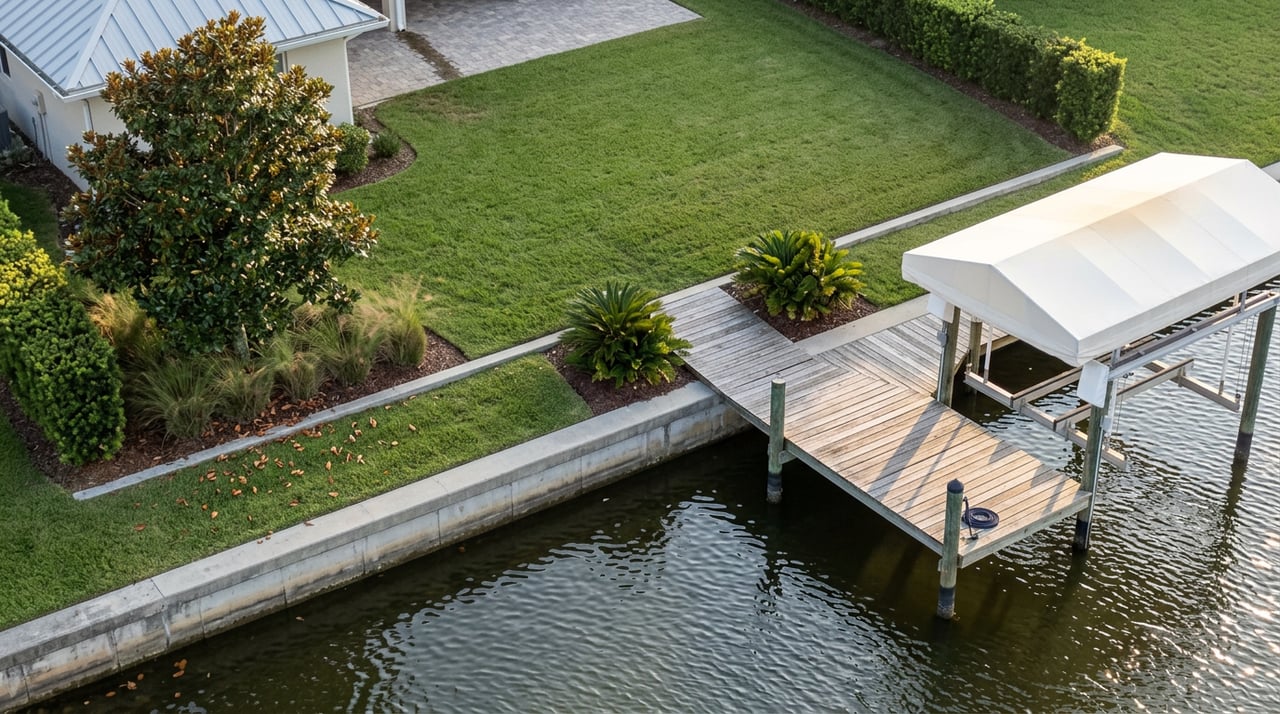
A buyer under contract on a Lake Butler property finds a boat lift, a seawall, and a dock that all look fine from the water. Then their agent pulls the permit history and finds nothing. No St. Johns River Water Management District record. No Orange County building permit. The dock has been there for years, the seller never touched it, and now the closing date is the thing that moves, not the price.
That is the pattern worth understanding if you are buying or selling on the Butler Chain of Lakes in Windermere. The obvious story is that lakefront costs more and needs a good inspector. The real story is narrower and more specific: on these eleven lakes, the paperwork trail on a dock or seawall determines how fast and how cleanly a deal closes, often more than the size of the lot or the number on the listing.
State and County Permits Are Separate
Most buyers moving from an inland subdivision to waterfront expect one inspection and one permit process, the way it works for a roof or an HVAC system. Where permits are required, the state and county processes are separate.
The state side comes from the St. Johns River Water Management District, which issues an Environmental Resource Permit for projects that require one. Applications go through the district's online ePermit system, and standard residential projects typically take 60 to 120 days to clear. That timeline alone can outlast a typical 30 to 45 day closing window if a buyer discovers mid-contract that a structure was never permitted.
The county side is separate. Where required, Orange County has its own building and zoning permit for docks and seawalls, separate from state approval, according to the OCSA Club. One approval does not substitute for the other. A structure can have a clean state file and still be missing a required county sign-off, or the reverse.
The Chain's Own Protection Status Works Against a Fast Close
Here is the detail that catches people off guard. The Butler Chain, which includes Lake Down, Wauseon Bay, Lake Butler, Lake Louise, Lake Isleworth, Lake Tibet-Butler, Lake Chase, Lake Blanche, Lake Sheen, Pocket Lake, and Fish Lake, carries Florida's Outstanding Florida Waters designation, a status meant to protect water quality and habitat. That protection is good for the lake. It is also the reason the exemption rules here are stricter than on an average Florida canal.
Florida Statutes section 403.813, a private dock can skip the full state permitting process if it is no more than 1,000 square feet of over-water surface area on most Florida waters. On an Outstanding Florida Water like the Butler Chain, that exemption threshold drops to 500 square feet. A dock that is more than 500 and no more than 1,000 square feet might qualify as exempt on a typical Central Florida canal but needs a full Environmental Resource Permit here simply because of which lake it sits on.
| Dock size | Standard Florida waters | Outstanding Florida Waters (Butler Chain) |
|---|---|---|
| Exempt from full ERP review | Up to 1,000 sq ft | Up to 500 sq ft |
| Requires full state review | Over 1,000 sq ft | Over 500 sq ft |
That halved threshold means a dock that looks modest by lakefront standards, big enough for a boat lift and a sitting area, can already be over the exempt size on the Butler Chain even though it would clear the bar somewhere else in the state.
The Grandfather Clause Has One Condition
The Florida Department of Environmental Protection explains that Florida's Outstanding Florida Waters rule grandfathers permitted activities and structures that existed on the date of designation. But that protection has a single condition attached: the structure has to stay in the same configuration. The moment a dock is widened, a lift is added where one didn't exist, or a seawall is rebuilt in a new footprint, the grandfathered status ends and the project falls under full current-day review.
The same logic applies to seawalls specifically. Restoring a seawall at its previous location is treated as exempt from the Outstanding Florida Waters permitting rule, but that exemption does not remove the separate permitting requirement under Florida's coastal construction statute. In practice, that means a seller who wants to repair a failing seawall before listing still has to pull a permit even for a like-for-like rebuild, and a buyer inheriting an older seawall should ask whether any past repair happened with or without that paperwork.
Seawall repair on lakes like these runs roughly $500 to $1,500 per linear foot depending on condition and material, a cost range worth knowing before an inspection turns up cracking or tie-rod corrosion. On a typical Butler Chain lot with 75 to 100 feet of shoreline, that puts a full repair somewhere between $37,500 and $150,000, which is exactly the kind of number a buyer wants to see resolved during the inspection period rather than negotiated after closing.
Where This Shows Up Most
The friction concentrates in specific places on the chain. Inside gated enclaves like Isleworth or Keene's Pointe, docks and community boat facilities are often permitted and maintained as part of the association's infrastructure, with the paperwork bundled into HOA records. Historic lakefront streets in the Town of Windermere itself, including Eichelberger, Interlachen, and Lake Ave, carry older homes on Lake Butler frontage that were never part of a gated community. These properties tend to have more character and lower price floors than the gated enclaves, but they also carry more due diligence weight, because there is no association tracking permit renewals or maintenance schedules on the owner's behalf.
Public access to the chain is limited enough that this paperwork matters even more. The Town of Windermere maintains a boat ramp off Main Street onto Lake Butler, and Orange County's R.D. Keene Park and Boat Ramp at 10900 Chase Road, along with the access point on Conroy-Windermere Road across from the Isleworth entrance, cover most of what the public can use on Lake Down. Everyone else reaches the water through a private dock. When that dock's legal status is unclear, the property's actual usability is unclear too, not just its resale value.
A Short Checklist Before Making an Offer
- Request the SJRWMD permit number for any existing dock, lift, or seawall and verify it through the district's ePermit search rather than taking the seller's word for it.
- Ask whether any required Orange County building and zoning permit exists separately from state approval. Any required state approval and county permit need to be on file.
- Compare the current footprint of the dock to what the permit describes. Any mismatch means the grandfathered status may already be void.
- Get the recorded shoreline footage from the survey.
- If the seawall shows cracking, settlement, or tie-rod corrosion, get a marine contractor's estimate before closing, not after, using the $500 to $1,500 per linear foot range as a starting point for negotiation.
Why This Matters More Right Now
Windermere's MLS showed 303 active listings as of August 22, 2026, a meaningfully looser market than the tight inventory of recent years. More competition among sellers changes what wins an offer. When two comparable lakefront homes are on the market at the same time, the one with a documented, matching permit file for its dock and seawall is the one that avoids a 60 to 120 day state review surfacing mid-contract. In a market where buyers finally have options, a clean paperwork trail is a faster close, and a faster close is what actually competes.
A Few Questions Worth Answering Directly
Can a home sell if its dock was never permitted? Yes. Most lenders and title companies will still close.
Does a grandfathered dock stay grandfathered forever? Only as long as it stays in its original configuration. Any expansion, including adding a lift or extending the platform, ends the grandfathered status and triggers a full current review.
How long should a buyer budget for a state permit review if one is needed? Standard residential Environmental Resource Permit applications through SJRWMD typically take 60 to 120 days. Larger or more complex projects can run longer.
If you are looking at a Butler Chain property and want the permit history pulled and read correctly before you write an offer, or you are getting a Windermere lakefront home ready to list and want the paperwork clean before a buyer's agent finds the gap first, reach out to Omar Cotto. Let's Connect.
This article is general information, not legal, tax or financial advice. Consult a qualified professional about your situation.